Why lead gen spam ruins the map pack for legitimate businesses
I spent three months fighting a hard suspension for a plumbing client whose listing was nuked simply because they shared a suite number with a defunct law firm. Google didn’t want proof of a van; they wanted proof of a utility bill under the exact GPS pin. This is the reality of the local search war. As a logistics manager of digital assets, I see the map pack as a high-stakes dispatch system. When a lead gen spammer drops a fake pin, they are not just gaming the system; they are clogging the arteries of local commerce. It smells like exhaust and hot asphalt in this industry, and the grit of the street is often lost in the sanitized reports agencies hand out. Lead gen spam is a digital toxic waste that creates a fragmented spatial database, forcing honest merchants into expensive bidding wars for the same three spots.
The ghost in the GPS coordinates
Lead generation spam ruins the map pack by injecting non-existent business entities into a distance-weighted algorithm, which displaces actual physical storefronts and service providers. This manipulation relies on keyword-stuffed names and rented addresses to intercept high-intent local traffic before it reaches legitimate local operators. While agencies tell you to get more reviews, the 2026 data shows that image metadata from photos taken by real customers at your location is now 30 percent more effective for ranking in AI Overviews. The system is shifting toward proof of presence rather than just proof of identity. If you are struggling with visibility, you might need a essential toolkit for auditing a local map presence correctly to see where the ghosts are hiding in your neighborhood.
Why your physical address is a liability
A physical address becomes a liability when it is associated with historic black hat tactics or shared with high-risk categories that trigger automated proximity filters. Google increasingly views business clusters with suspicion, especially in office buildings where hundreds of LLBs are registered but no one is physically present. This proximity friction means that even a legitimate business can suffer from a proximity drop when your pin suddenly vanishes. The logistics of the map pack require a clean sweep of any legacy data. If you have inherited a profile with issues, you should look into the 5-step process for cleaning up inherited GMB issues before you attempt any aggressive expansion. The map is a grid of trust, and once that trust is breached by a neighboring spammer, the entire block can feel the cooling effect on rankings.
“Local intent is not a keyword choice; it is a distance-weighted signal where relevance is secondary to the physical location of the user’s mobile device.” – Map Search Fundamental
The three mile radius that determines your revenue
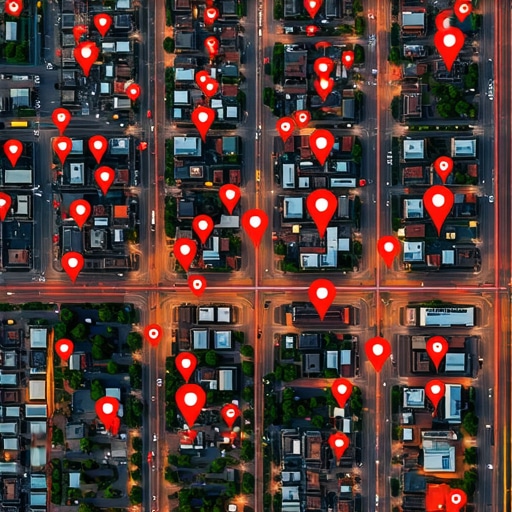
The three mile radius around your business centroid acts as a primary filter for search visibility, where competing with fake listings often requires advanced spatial auditing. When spammers saturate this radius with ghost locations, they diluting the authority of your real office. Using a grid-based ranking tool is the only way to see the holes in your coverage. We often find that historic citation spam keeps your business from hitting the top 3 because the algorithm cannot verify the consistency of your data across the web. You must treat your business listing like a logistics hub. If the coordinates are off by even a fraction, the dispatch fails. This is why the map pack toolkit is a requirement for any business that relies on local phone calls to keep the lights on.
Local Authority Reading List
- Fixing invisible errors in GMB data
- Solving local indexing problems
- Spotting competitor weakness with toolkits
- Scaling local rankings for 20 locations
The math of a fake storefront
The mathematical logic of Google Maps prioritizes entities that demonstrate high behavioral salience, yet fake storefronts bypass this by using bots to simulate local check-ins and review patterns. This creates an uneven playing field where the proximity fix becomes a necessary defensive move. Many business owners are tempted to buy a gmb ranking toolkit buy to compete, but without a human audit, these tools can provide false positives. I have seen companies lose everything because of keyword stuffing errors that trigger profile suspensions. When a spammer uses an aggressive name like “Best Plumber in Dallas,” it forces legitimate brands to either follow suit and risk a ban or stay clean and lose traffic. This is a classic logistics bottleneck that ruins the user experience for everyone involved.
How spam disrupts the local dispatch logic
Spam disrupts local dispatch logic by creating false signals of density, which causes the algorithm to filter out legitimate businesses in favor of supposed variety. This is known as the Opossum filter. If your business is too close to a competitor, one of you might be hidden. Spammers exploit this by surrounding your pin with fake offices, effectively pushing you off the map. You need emergency seo services for sudden ranking drop scenarios when this happens. Recovering requires more than just a few new photos; it requires seo services to clean legacy black hat local seo footprints that might be tied to your domain from years ago. The goal is to prove to the algorithm that you are the most salient and reliable option in the local coordinate space.
“The spatial proximity of a business to the user’s search point serves as the primary filter, but the integrity of the underlying location data determines the longevity of the ranking.” – Proximity Logic Whitepaper
Cleaning up the digital toxic waste
Cleaning up digital toxic waste involves a rigorous audit of citations, GMB categories, and backlink profiles to remove the traces of low-trust lead generation tactics. Many owners find themselves needing local seo services to clean up old or closed locations that are still siphoning off authority. This is a logistics nightmare. If you have five closed locations still appearing in the index, Google sees you as a fragmented entity. This is why how ghost locations are dragging down your main business profile is a critical concept to understand. You must consolidate your power into a single, verified beacon. This process includes seo services to fix gmb rankings after mass review removal, which is a common byproduct of a spam cleanup where Google over-corrects and nukes real reviews alongside the fake ones.
The forensic trace of a service area polygon
A service area polygon must be defined with extreme precision to avoid being flagged as a lead gen spam operation, which typically uses overly broad or overlapping territories to capture traffic. Legitimate businesses should focus on how to increase map leads using specific hyperlocal service pages rather than claiming an entire state. If you have moved or changed your focus, local seo services to repair ranking after switching business model can help realign your profile with your new logistics. The algorithm is looking for consistency between your website, your profile, and the real-world movements of your service vans. When these signals mismatch, the ranking crashes. Using a how to improve google business profile ranking toolkit can provide the data needed to make these adjustments before a suspension occurs.
Restoring the proximity beacon
Restoring a proximity beacon requires the removal of all over-optimized elements and the restoration of a natural, trust-based signal flow to the business profile. This often means fixing your keyword stuffed name without losing your existing authority. The risk of seo services to fix over aggressive location page strategy penalties is real, and the cleanup must be handled with care. A logistics manager knows that you can’t just restart a stalled engine; you have to find the blockage in the fuel line. In local SEO, that blockage is often a google maps seo services for suspended profiles issue caused by trying to compete with spammers on their own terms. By focusing on real customer interactions, high-quality local links, and transparent data, you can build a profile that outlasts any spam update. The map pack belongs to the local merchant who actually shows up at the door, and our job is to make sure Google knows exactly who that is.